
The Rise of the 'Skill Nomad': How AI is Redefining the Future of Work
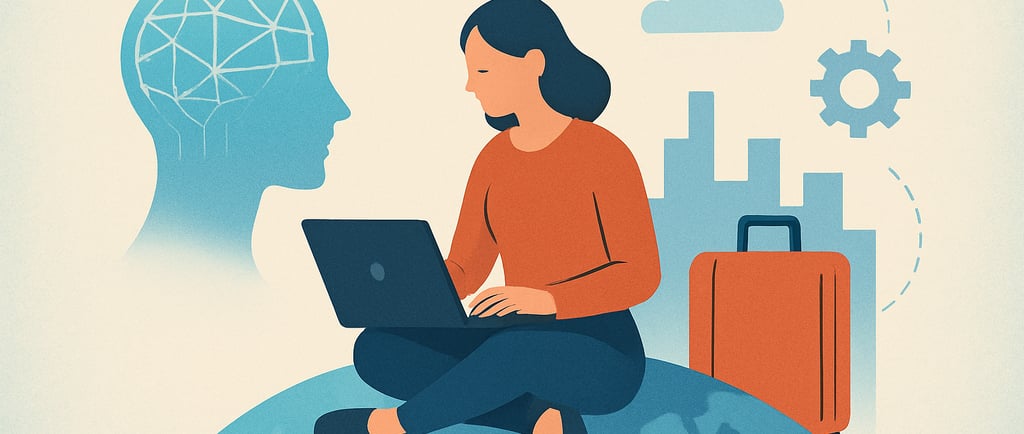
AI workplace debates have fixated on job loss or leisure utopias, but as tools become daily collaborators, a nuanced shift emerges: not job elimination, but worker identity redefinition. Enter the "Skill Nomad"—the adaptable, ever-evolving professional.
Rohit Nandha
11/11/20252 min read
The End of the Linear Career Path
For generations, career success was visualized as a ladder: a single, upward trajectory within one company or industry. AI, particularly generative AI, is shattering this model. By automating repetitive and digitally centric tasks—from data entry and basic coding to drafting emails and generating preliminary designs—it is rapidly de-emphasizing the value of static, specialized knowledge.
This is where the Skill Nomad thrives. They are the employees who see their careers not as a ladder, but as a mosaic of evolving competencies. They are driven by the need to continuously shift between roles, industries, and project types to remain relevant. Their professional journey is marked by reinvention, valuing a broad, fluid skill set—often called "T-shaped" or "M-shaped" skills—over deep, unchanging specialization.
From Tool User to AI Collaborator
The change isn't just in career path; it's in the daily workflow. The modern worker isn't just using AI; they are collaborating with it. Tools like Microsoft Copilot and Google Gemini are becoming a new kind of "trusted ally" that employees turn to for everything from validating ideas to solving complex, novel problems.
For the Skill Nomad, expertise is increasingly measured by "AI literacy": the ability to effectively prompt, manage, and audit the output of intelligent systems. This means a new premium on uniquely human skills like:
Critical Thinking and Oversight: Knowing when the AI is wrong and why.
Interpreting Results: Translating AI-generated insights into actionable, human-centric strategy.
Emotional Intelligence: The irreplaceable skills of client negotiation, team leadership, and creative persuasion.
A New Philosophy of Work-Life Balance
To sustain this high-velocity evolution, the Skill Nomad embraces practices that would have once been seen as "disengagement." One such trend is "micro-retirements": short, intentional career breaks taken to recharge, learn a new, in-demand skill (like a new AI framework or a sustainability certification), or pursue a personal passion.
These breaks are not a sign of instability but a strategic investment. The new workforce values autonomy, flexibility, and lifelong learning, viewing rest and upskilling as necessary components of peak performance in an AI-driven world. The perception gap is real—employers may see these breaks as job-hopping, but employees see them as essential for adaptability.
Ultimately, the rise of the Skill Nomad suggests that the most future-proof career isn't one with the highest title in a single field, but one defined by unyielding adaptability and continuous self-reinvention in partnership with technology. The future of work belongs to those who are willing to be students for life.